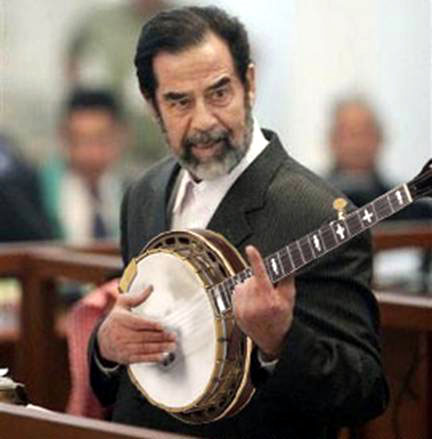
Take a good look at the man pictured to the left. Don't let his flaxen locks distract you. Instead, focus your attention on the beady dots of coal he calls his eyes. But don't let your gaze linger too long, because verily I tell you that this is the face of all that is evil. The name that this harbinger of the apocalypse goes by is (I kid you not) Mutt Lange, and it has come to my attention that he intends to destroy music as we know it.
The first sign that this man is not to be trusted is his name. Mutt? Really? With a name like that you'd expect he'd be the dimwitted bouncer in a roadhouse saloon or a cartoon spokesman for bacon flavored dog treats (if the Beggin' Strips people steal my idea I'm suing them for everything they have). The worst part of it is that he was born with a perfectly wonderful first name, Robert. Anyone who decides that Mutt would be a better show business name than Robert should never be allowed near a recording studio. And yet, somehow this disgusting wretch of a man has become one of the most successful record producers in all of popular music.
But Mutt didn't start destroying music right out of the gates. No, early on in his career he produced some sporadically palatable albums by bands like the Cars and AC/DC (including their landmark album Back in Black). The importance of the Cars' music speaks for itself. As for AC/DC, somebody had to write rock and roll songs about balls. And nobody has done it better than Angus Young and company.
But sometime in the early eighties something happened to Mutt. Perhaps somebody ran over a beloved pet, or maybe a demon laid eggs in his brain. Whatever it was, it dashed any hopes that Mutt might actually bring some good into the world. From that point forward, Mutt's "talents" were put to use recording some of the worst abominations in music.
To give you just a taste of the damage that this man has done to the world of music, here is an incomplete list of some of his most ignoble accomplishments:
Mutt has produced an album by Foreigner, two albums by Bryan Adams, one by Nickelback (one of this blog's favorites), one by Michael Bolton, and no less than four albums by everyone's favorite seven-armed, transvestite, cocaine monster lovingly referred to as Def Leppard. But Mutt isn't content to simply ruin rock and pop, he also has to pick on country as well. He produced four albums by Shania Twain, who incidentally was his wife up until 2008 (if there's a more textbook definition of a match made in hell then I'm not aware of it). Come on Mutt, hasn't country suffered enough? Garth Brooks already dug its grave, did you really have to piss on it too?
And these are just the albums he's produced. He's also had his filthy hands involved in the production of individual songs by such hemmorrhage-inducing artists as Huey Lewis and the News, Celine Dion, the Backstreet Boys, Billy Ray Cyrus, Britney Spears and the Jonas Brothers. The mediocrity makes my head spin.
His most recent assault on good taste is a song he helped produce on the new Lady Gaga record called "You and I" (there's an umlaut in there, but God help me I can't bring myself to type it). The song plods along like a morbidly obese man on his way to the buffet line. It's also a bizarre ode to the state of Nebraska, which ought to be your first warning sign. I don't count myself among Ms. Germanotta's legions of adoring fans, but even I have to say that Lady Gaga could do much better than Mutt.
Ok, I'm sorry...I've been holding this back throughout writing this, but I just can't do it anymore. I was trying to avoid doing any awful dog puns on the name "Mutt," but I have to open the floodgates. Beware, I'm letting all of them out at once...YOU HAVE BEEN WARNED
Mutt, it's an understatement to say that you've been a bad dog. Each new album you make is like a new "accident" left on the rug, and it's time someone start rubbing your nose in it. You're in the doghouse Mutt, and I'd prefer it if you'd stay in there forever. Or better yet, maybe it's time we give you the Old Yeller treatment and take you out behind the shed and put you out of your misery. You've been rubbing your ass on the carpet of popular music for too long Mutt. It's readily apparent that old dogs produce shitty albums, so it's time we sent you packing with your tail between your legs.
Let me begin by saying that I honestly really wanted to like Odd Future. They seemed right up my alley, a couple of young, fresh faced kids from the hip-hop underground with a growing reputation ready to destroy preconceived notions about hip-hop. I was completely ready for a latter-day Wu Tang Clan with more smarts. Yet, while the critical apparatus seems ready to crown them the next big thing, I'm left not just wondering what the fuss is about, but honestly angry that I even gave them as much credit as I did.
Like a lot of people, I was first introduced to the hip-hop collective Odd Future (short for "Odd Future Wolf Gang Kill Them All") a few months ago when the hype they had been generating for some time online reached critical mass and they began getting mainstream media attention. Specifically, I saw this performance on Late Night with Jimmy Fallon:
It's not difficult to see why I was drawn in by these guys. Tyler the Creator and Hodgy Beats are basically running a clinic on intensity here. Plus, from a strictly visual standpoint, they look like no one else in hip-hop. There are no designer clothes or pretentious sunglasses (yeah, I'm looking at you Kanye), no gold chains or diamond jewelry, none of the stereotypical bling of rap. Instead, you get what look like a couple of punk kids (and they are surprisingly young) scaring the daylights out of everybody in the studio. Needless to say, I was excited. I immediately found several of their mixtapes and began listening to them, excited to hear what I was sure would be some of the best hip-hop I'd listened to in a long time. I was instantly disappointed. What I heard was messy, poorly produced and completely lacking the intensity that had initially excited me about them in their live performances. What's more, the lyrics were completely unforgivable in every way imaginable. Not only were the lyrics shockingly misogynistic and homophobic, they weren't even well-written.
I'm embarrassed to admit that I wasn't ready to give up on Odd Future yet, I was still desperate to validate my initial excitement. I chalked up the lackluster recordings to a lack of careful production and decided I needed to give them a second chance. I also decided that I would reserve judgement until the release of the hotly anticipated album Goblin by Tyler the Creator (the de facto leader of the group) which I told myself would definitely be more on point and would live up to the promise of their live show. I was also convinced that I was just missing something, that obviously there was more going on here and I just wasn't listening carefully enough.
Well, after giving a thorough listen (following along with lyrics) to as much of Goblin as I could handle, I have the following to say about all of the press that Tyler and Odd Future have been getting: horseshit.
Honestly, never has an album made me as mad for as many reasons as this one has. To begin with, it's incredibly disappointing musically. Every bit of hype I had been reading about Odd Future praised Tyler as the true mind of the operation, a brilliant producer and a gifted lyricist. Well, I'm not buying any of it. First, in terms of depth and complexity his lyrics are a complete failure. Please, do not let anyone tell you that Tyler is a talented MC, he's just not. To pretend that he is destroys a music that I honestly believe can be incredibly powerful. If you want to hear a better hip-hop lyricist than Tyler the Creator, there are plenty of options I'd be happy to tell you about if you are interested in hearing about them. Secondly, in terms of production, I'm thoroughly convinced there is nothing special about what Tyler does on this album or any other I've heard from the Odd Future collective. I'll grant that his productions are something of a departure from most of hip-hop, and the horror movie ominousness is at least somewhat interesting on its surface. But that is basically the end of the story when it comes to the beats on Odd Future albums. To my ears, Tyler is a one-trick pony when it comes to his production skills. Everything is dark, ominous tones. All brooding and no direction.
But now it's time to acknowledge the elephant in the room. Because the most heinous aspect of Goblin or any of Odd Future's output is not the quality of the songs, it's the lyrical subject matter. Let me first say that I'm no friend of the PMRC and in no way am I advocating for censorship. It should also be noted that I have never bought the argument that violent lyrics cause people to commit violent crimes. So no, I am not afraid that teenagers will go out and try to imitate what they hear Tyler the Creator rap about in his songs, and I'll be the first to say that anybody who says otherwise is full of shit. Furthermore, I'm no prude, and I can more than handle any amount of profanity you could possibly throw at me and could probably dish it out better than most. So Odd Future's reputation for shocking and disturbing subject matter didn't scare me because I assumed that there would be a point to it all. But there isn't. And I can only put up with a rapper casually dropping the word "faggot" so many times before I begin to feel like it's only a cheap joke used simply for shock value. Worse, the almost incessant number of songs about rape and violence against women without any seeming moral commentary goes beyond what you could reasonably call story telling. Tyler and the gang don't even seem to have the decency to allow the opposite sex to be called "women," preferring instead to use any number of epithets, of which "bitch" is among the tamest.
I waffled quite a bit about whether I should even write this post, because a small part of me was afraid that I'd be accused of not seeing the bigger picture or over analyzing things. I've tried to look past my reservations and see some value in this music, but I'm convinced there isn't and I'd be lying to myself if I tried to pretend otherwise. What's more, I am disgusted by the seeming unwillingness on the part of music critics to actually be critical. It's downright unconscionable for the people at Pitchfork and elsewhere to act morally indifferent to Odd Future by writing about how the music is "controversial" or "divisive" instead of what it really is: misogynistic, hateful and downright pathological. Scant few people within the critical community it seems are willing to try and derail the hype machine surrounding this group. One notable exception has been a recent blog post by Sara of the band Tegan and Sara which criticizes the homophobia and misogyny of Tyler's music. The post is poignant and essential reading. Predictably, when Pitchfork linked to the blog post, they did perfunctorily and without any sense that perhaps it was time to step back and take note of what Sara was saying.
I chalk this lack of criticism among the music press up to cowardice. Perhaps the critics are afraid to get steamrolled by a seemingly overwhelming following that Odd Future has garnered in a short period of time. Maybe they think criticizing the lyrical content will make them look like prudes who can't take a joke. Whatever the reason, the complete unwillingness for the critical apparatus to hold Odd Future up to scrutiny is astounding coming from an industry whose entire purpose for existence is to provide subjective commentary about music. Any attempt at objectivity here is completely misguided and pointless. At some point, somebody has to have the intestinal fortitude to stand up and call these artists out. The fact that almost nobody in the power circles of music criticism is willing to do this is shameful. It's time for the critical community to acknowledge that at best this music is the product of a couple of immature dumbasses, and at worst it is the product of sociopaths with no regard for human decency.
I want to make one other thing absolutely clear about Odd Future. The notion that there is something deeper going on in this music than the surface level misogyny and homophobia, or that Tyler is making some kind of meta-criticism of society is a towering pile of bullshit. And the idea that these songs are not meant to be taken literally because they are simply a depiction of what is going on around us is a cop-out of the highest order. Those things could perhaps be said about some of the controversial artists in hip-hop history (NWA, Ice-T and Public Enemy being some of the prime examples) but at some point an artist has to show a glimmer of understanding what exactly they are doing with their lyrics. The best rappers (including some of those in "gangster rap") can do this quite well. Odd Future, however, have not proven themselves capable of this kind of deeper understanding. When they rap about rape and violence, they do so with absolutely no tact or purpose. They are shock for the sake of shock, with no real redeeming value.
I'm sure some people might say that I'm being overly harsh, or that I just don't understand. Perhaps, though I doubt I'm being harsh enough. And I'm also sure that my ranting and raving will do nothing to curb the hype surrounding Odd Future and would only cause derision and mockery from the members of the group if they were to read it. But, I'm not going to sit idly by and watch it all unfold without any commentary. I'll leave you with a little gem from Tyler the Creator's song "Yonkers" which pretty well sums up how he would feel about someone like myself:
They say success is the best revenge So I beat DeShay up with the stack of magazines I'm in Oh, not again! Another critic writing report I'm stabbing any blogging faggot hipster with a Pitchfork
How lovely.
Based purely on outward appearances, Tune-yards is a "band" that gave me pause at first. The day-glow face paint and hipster haircuts almost sent me running for the hills. But thankfully my mama taught me not to judge books by their covers or musicians by their haircuts, because musically this band delivers some pretty interesting material.
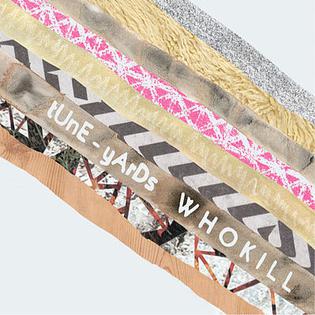
Whokill is the second full-length album by Tune-yards (and no I refuse to use the stylized tUnE-yArDs or W H O K I L L throughout this post). The "band" is essentially a Merrill Garbus solo project with some backing musicians to fill out the sound. Garbus herself plays the ukulele, creates live drum-loops and sings. On Whokill she also enlists the help of a bassist, guitarist and saxophone section.
What stood out about this album to me was its completely unique sonic profile. There really isn't a band out there that sounds quite like this. There are a few recognizable influences (funk, jazz fusion and afro-beat to name a few) but none that really come to the forefront as a dominating influence. And yet Tune-yards isn't genreless in the way that so many other groups are, by piecemealing different styles together into some sort of Frankenstein creation. This album is something of a novelty in modern music, a sound that is actually new. There's a freshness here that makes me wonder (and hope) if what I'm hearing is a taste of what is to come in rock and pop. It's the same kind of feeling I got when I first heard TV on the Radio.
Disjointed and chaotic are two words that immediately came to mind when I first listened to Whokill. Part of that is Garbus' loop-based compositional style, but another huge factor is her completely otherwordly voice. She is constantly playing vocal gymnastics, leaping from a surprisingly deep growl to a high thin falsetto within the space of one syllable. The production quality is also outstanding on all of the songs here, which works in spite of the distinctly lo-fi charm of her first album. Perhaps die-hard Tune-yard fans will think this album is too polished, but I think the added production quality shows off Garbus' ear for arranging and makes the band sound much larger than it really is.
But it must be noted that Garbus' sound really only works the way it should when she lets you have it full-force. The week points on this album are without a doubt the more downtempo quiet moments like "Wooly Wolly Gong" where she begins to sound too much like a typical singer-songwriter, a guise that doesn't fit her as well as it should. Tune-yards only really seem to hit their stride when the music kicks into higher gear on tracks like the opener "My Country," the tongue and cheek toughness of "Gangster" or the lead single "Bizness." In general though, when Garbus lets her songs rock a little bit harder, her unique songwriting comes out more and creates some pretty exciting music.
Below is the video for "Bizness" which cranks up the hipster something fearce, but is worth sitting through for the music.
Audio Lobotomy is a new masochistic feature of Universal Sandwich. Each installment of Audio Lobotomy will consist of an unholy experiment whereby I subject myself to the absolute worst albums I can get my hands on in the name of science. During each experiment, I will record my reactions to the songs as I listen to them so that I may document their effect on my psyche. In short, I listen to terrible music so you don't have to.
Today's experiment is Nickelback's 2005 album All the Right Reasons.
Impressions going in:
Nickelback are pretty much the undisputed reigning kings of Sucksylvania. That is both the beginning and the end of my knowledge about this band and their music. I actually had to do a little googling to even decide which of their godawful albums I should use because I knew so little about them. I ended up choosing All the Right Reasons because the internet tells me it is their best selling album, which has to put it right up there with the Titanic or the Hindenburg on the list of history's worst man-made disasters. I'm certain I've heard at least half a dozen Nickelback songs on the radio before, but for the life of me I can't bring any of them to mind. Looking over the song titles on all of their albums doesn't jog my memory either. I keep trying to hum the chorus to one of their songs, but every time it just ends up being Creed's "Higher." Something tells me that's not a good sign. Also, it turns out Nickelback is from Canada. Make of that what you will...
The Songs:
1) Follow You Home - Here we go...
The guitars at the beginning alone tell me this is a band that takes itself entirely too seriously. Ooo, the lyrics are all dark and gritty. Obviously this guy's a rebel. Is there like a rhyming dictionary of bad-boy cliches? Because if not, I think Nickelback could write it.
2) Fight for All the Wrong Reasons -
Apparently repeating each line in a whisper is totally fucking metal. Ugh, this song is kind of disturbingly sexual. I do not like thinking that being in Nickelback can get you laid. We just had our first cookie monster scream on the album, you know what that means, DRINK! And, somehow that's immediately followed by a Bohemian Rhapsody-like vocal overdub section.
3) Photograph - Ballad time! Ok, so this one I recognize. It seems like the kind of song that the student senate in high school would totally choose as your "class song." I can just see the sepia-toned photo montage now. Nostalgia - making half-wit rock stars even richer since 197? Seriously, I don't know how many ways this band can find to say "think about the past and get sad, and then buy our album."
4) Animals - Ok, now we're back to melting faces. First mention of the devil, boy didn't see that one coming a mile away. It sounded like he just said "manimals." I think I actually like that better. "Must have wound up on the floor while we were switching our positions/ I guess they knew that she was missing/ As I tried to tell her dad it was her mouth that I was kissing." Excuse me while I vomit all over my keyboard.
5) Savin' Me -
Leaving the "g" off of "saving" tells the listener that this is a band that isn't afraid to let its hair down. I'm pretty sure this song is just a holding pattern for an EPIC CHORUS. A big echo effect over the repeating line "I'm fallin'" is the kind of touch that only a band known for its subtlety like Nickelback could pull off.
6) Far Away -
Ok ladies, it's acoustic guitar time, get ready to swoon. Kroeger's voice is kind of like vigorously rubbing sandpaper on your genitals. Add to the list of disgustingly transparent studio effects a distant echo effect on the lyric "Far Away." Seriously, where do they get this stuff?
7) Next Contestant -
So, the line "Just how many heads I'm tearing/ Off of assholes coming onto her" scans alright on paper, but the way he delivers it makes it sound like he's doing something unspeakable to your no-no area. Basically this song is "I'm a bigshot rockstar with a super hot girlfriend, and if you look at her sideways I'm gonna beat you up, or at least sing an angry song about it." Oh good, he just blamed the girl getting harassed on the outfit she's wearing. Classy.
8) Side of a Bullet -
So, if the title isn't enough of a giveaway, this one's another face melter. You know, when I think of bands with the intelligence and subtlety to pull off a song about gun violence, Nickelback is definitely the first band that comes to mind. If I'm remembering correctly, this song was meant as a eulogy to Dimebag Darrell. Way to throw salt in everyone's wounds, Nickelback!
9) If Everyone Cared - Piano ballad time, brace yourself for suckitude. Hmm...I wonder which Hallmark greeting card they stole the lyrics to this song from. My heart is so warmed, I can't stand it. Or maybe I ate too much spicy food for lunch.
10) Someone that You're With -
This song pretty much consists of one ham-fisted four-note guitar riff repeated ad-nauseum. They just keep at it, even if it doesn't fit the lyrics anymore. That's persistence....or something.
11) Rockstar -
Last song, the light at the end of the tunnel. Oh great, it's a country song. Just what this musical abortion needed. Ahh...yeah, this chorus, I remember this too. I wish I hadn't. Rhyming tassels with assholes takes things to an all new level of ineptitude. Shout out to Pez dispensers = best part of the album so far. I've never known anybody who could make sex, drugs and rock and roll seem so unappealing until now.
The final verdict:
Nickelback's frontman Chad Kroeger is a musical genius the likes of which Rock has never seen. The dulcet tones of his voice and the soaring melodies in each Nickelback song are sublimely transcendent. What's more, his songwriting abilities make him a modern day Dylan. His lyrics display subtlety and nuance while still letting you know what a totally bitchin' badass rockstar he is. I can hardly wait to listen to more Nickelback so that I might drink from the fountain of pure enlightenment.
Just kidding! This thing sucks like the wind. I'm gonna go wash my ear canals with sulfuric acid.
If you have any suggestions for other terrible albums I should torture myself with, please email me at scott.unlsandwich@gmail.com
Leftovers is an ongoing feature of Universal Sandwich which unearths buried treasures of the music world. In each episode of Leftovers, I dig out the choicest of the moldy gems from the back of the Universal Sandwich fridge and explain why I think they are undeserving of the trash heap.
On today's plate of Leftovers is a bit of live music obscurity from February 4th 1990. Daniel Johnston is unfortunately more known for his mental instability than his remarkable songwriting talents. But if you look beyond his lifelong battles with mental instability you will find one of the rawest, most gut-wrenchingly honest songwriters ever.
This recording comes from an hour long variety show that Daniel did on WFMU. Daniel had pre-recorded advertisements, jingles, and fake interviews with Daniel voicing all of the parts and then playing them over the phone to be broadcast over the radio. But the shining moment in all of this was when he sang his song "Speeding Motorcycle" over the phone with the help of the band Yo La Tengo who had been booked for an in-studio performance.
What results nothing short of a lo-fi masterpiece. This performance is oozing with a sort of naive charm that any other artists would die to have. The innocence and child-like exuberance is apparent in Daniel's voice. And the way that Yo La Tengo are able to tenuously hang on to the performance using what they could hear over the phone is nothing short of incredible. The sound quality, is of course sub-par, and Daniel's voice may take some getting used to, but this is all overshadowed by the goofy boyishness of Daniel's voice which perfectly match lyrics like this:
speeding motorcycle
of my heart
speeding motorcycle
lets be smart
because we dont want a wreck
we can do alot of tricks
we dont have to break our legs
to get our kicks
They're silly, of course, but underneath that there is a kind of sophistication, an ability to explain something as complicated as love with a child's sense of simplicity.
Listen to the track below, and you can also find the entire broadcast of which it is a part here.
Yesterday the Beastie Boys released the video for the single "Make Some Noise" off their upcoming album Hot Sauce Committee pt 2 due in stores next week. The video is part of a longer short film which premiered at Sundance Film festival this year. The video has cameos from seemingly anyone who has every played a comedic role in Hollywood, and the performance by Elijah Wood as a young Ad Roc is particularly spot-on.
The hip-hop community has an obsession with crowning new royalty. It seems that every time a new buzzworthy artist crops up, the discussion inevitably turns to whether or not he or she is the next great hope. When people aren't arguing about whether or not hip-hop is dead, they are debating who can save it. Hip-hop's de facto savior du jour for the past six or seven years has undeniably been Kanye West. The producer turned rap superstar has enjoyed near universal acclaim since his debut album College Dropout in 2004. His sales are among the highest in the industry and every new release is a major event. Seemingly the only person more impressed by Kanye West than the fans and critics is Kanye West.
And therein lies the problem. West's ego is an entity unto itself. By now it has consumed the rest of his personality to the point that the only thing remaining is a comically absurd real-life Tracy Jordan. The listening public seem more than happy to look past his rampant materialism, his inflated sense of self and his public temper tantrums when he doesn't get the recognition he feels he deserves from award shows. They are willing to look past all of that because Kanye West, as he is not afraid to keep telling us, is a "great artist." Well, I hate to be the turd in the punchbowl folks, but when it comes to rapping, he isn't even very good.
Is he a gifted producer? Absolutely. Is he at least a tiny step above most top forty rappers when it comes to lyrics? Perhaps, but only just barely. At the end of the day, for me West is 90% hype and only 10% substance. His last 3 or 4 records in particular are filled with graceless goofy lyrics that, while they make a pretense to depth or profundity, are ultimately uninspired. What's most irritating about Kanye West's fame is that it completely overshadows the truly talented artists in hip-hop. It's a tragedy, and one in which I think fans and critics are complicit. By passing him off as the great creative mind in modern hip-hop, the hive mind is telling the unwitting public that they need look no further than Kanye West when looking for the best and brightest in hip-hop. But I've seen what a truly gifted MC can do. I've heard verses from artists with a fraction of West's album sales that are powerful, that make you weep, that astound you with their honesty. I've also heard verses where it's clear that the MCs aren't taking themselves too seriously. These artists are self-aware and are willing to look at themselves and hip-hop with a critical eye, to be self-deprecating. And that's something that Kanye West is simply not capable of.
I've heard it speculated that West's larger-than-life persona is all part of the show, that his ballooning ego is some kind of meta-critical performance art. While this is an interesting theory, I just do not buy it. If Kanye West is to hip-hop what Stephen Colbert is to punditry, then I think he would have to be much funnier than he is. Sure, his antics can be amusing from time to time, but I see him in the same light as Charlie Sheen. You cannot help but laugh a little bit at the absurdity of it all, but it seems more like schadenfreude than anything.
It should be said that Kanye West is far from being the first hip-hop artist to have a large ego. And I want to make it clear that I'm not saying that ego and braggadocio don't have their rightful place at the hip-hop table, they do. In fact you can trace this kind of attitude back to hip-hop's earliest days when teenagers in the Bronx were battling each other (on the mic as well as on the turntables or the dance floor). But the difference here is that Kanye West isn't some young kid trying to carve out a name for himself in a ghetto where every brown face is just another statistic. He's a multi-millionaire who is known worldwide, and if he isn't self-aware enough to laugh at himself every once and awhile, then the whole thing falls apart.
Okay, so if Kanye West is not worthy of the hip-hop crown, then who is? Well, that's a question that I'm afraid to say I do not have an answer for. The problem I see is that if hip-hop needs a savior (and I'm not completely convinced it does), then that artist must be able to combine talent with a willingness to be self-aware while still being popular enough to reach a wide audience. I don't see anyone on the scene right now who can do all of that. The closest I can think of is someone I wrote about recently, Lupe Fiasco. Yet, while he's definitely more talented than Kanye and certainly popular, he still suffers from an inability to let his ego take a backstage to talent. He's ultimately Kanye in new clothes. Artists like Mos Def and Talib Kweli who have the ability to write truly gut-wrenching lyrics do not enjoy nearly the amount of popularity that Kanye West does. And artists willing to take the piss out of hip-hop and themselves like Busdriver don't even come close.
What it all comes down to is that the listening public has to start being better fans. I think Kanye's biggest problem is that he's decided that he is the only person who can "save" hip-hop and nobody wants to tell him otherwise. If fans and critics aren't willing or able to see through the cloud of hype surrounding Kanye West, then he will only continue to think that he's God's gift to music. At the end of the day, if hip-hop needs to be saved from anything, it's Kanye West.
Somewhere in Colorado lives a lowly hermit named Scott. Some time ago he emerged from the bloated, seedy halls of academia with nothing to show for himself but a piece of paper reading "musicologist" and a sour disposition. Since then, he has spent his days scratching rants and diatribes into the walls of the dark musty cave he calls his home. His sickness seems primarily musical in nature, as evident in the subject matter of his writings. Topics of discussion in these deranged inscriptions include why Captain Beefheart was the true king of Rock and Roll and the proper volume at which a Clash album is to be played (quite loud). For reasons not fully understood, he began calling his disturbed chicken scratches "the Universal Sandwich." His delusional ravings are presented here in this blog without commentary, so that they can teach us something. If not something about music, then they should at least serve as a cautionary tale about madness in the modern age.






 Posts
Posts